
Maritime
Marine Insurance Enquiries: Preparing Facts, Policies and Loss Information
A marine insurance enquiry needs more than a description of an unfortunate voyage. The adviser or insurer may need to understand the relevant policy, insured interest, shipment, incident and steps taken after the loss. A well-organised file helps separate what is known from what still requires investigation.
This preparation guide does not determine cover or liability. Policy interpretation, notification requirements and any claim procedure require advice on the actual documents and facts.
Identify the policy and interested parties
Gather the complete policy wording, schedule, endorsements and relevant placement correspondence. Record the entities involved and the interest each is said to hold in the goods or operation. Do not rely on a certificate or summary as if it necessarily contains every applicable term.
Identify any other policies or contractual risk arrangements that may be relevant without assuming they provide overlapping cover. A qualified review can then address the relationships between the documents and the actual incident.
Describe the incident as a chronology
Record the route, dates, cargo, vessel or transport information and the sequence in which the problem became known. Distinguish a reported event from an independently observed fact. Note who inspected the goods and where they were located at that time.
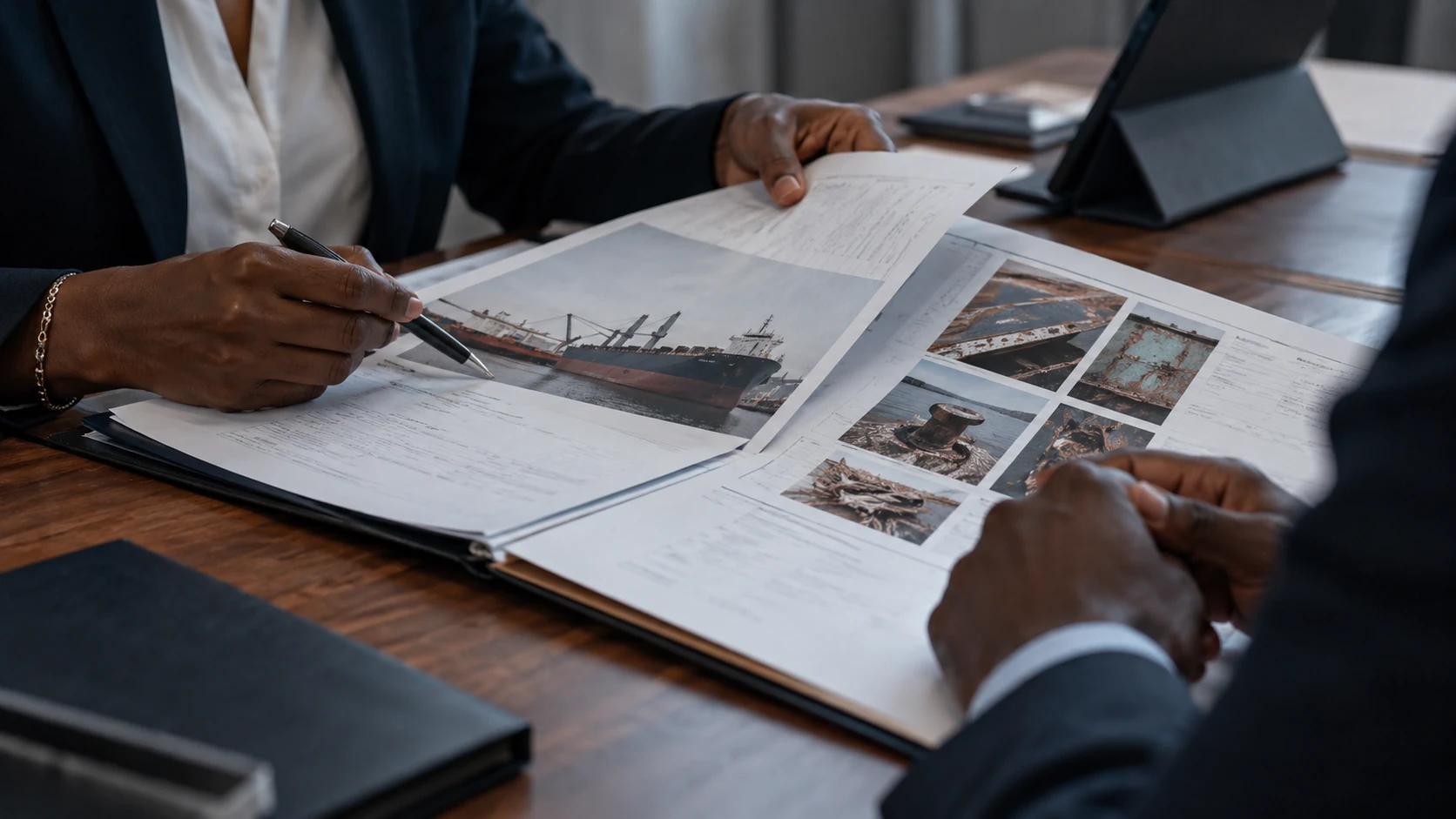
Include photographs, delivery records, survey material and correspondence in their original form. Mark any unexplained gaps. It is more useful to identify an unknown event than to supply a confident but unsupported explanation.
Preserve the communications record
Collect notifications already made, their recipients and the evidence of delivery. Ask promptly whether further communication or action is required. A commercial report to a broker or carrier should not be assumed to satisfy every relevant policy or contractual requirement.
Keep the language of early communications factual. If responsibility or cover has not been assessed, avoid presenting an initial assumption as a settled conclusion. Obtain suitable advice before making commitments that may affect the response.
Explain the loss calculation
Organise invoices, quantities, condition information, estimates and costs incurred. Show how the calculation was prepared and which figures remain provisional. Record any proposed salvage, repair, replacement or disposal decision and the advice received about it.
Commercial loss and policy response are not the same question. A business may have suffered an interruption or customer complaint whose treatment needs separate examination. A complete calculation helps reviewers identify these distinctions.
Coordinate the people involved
Identify the insurer or broker contact, surveyor, carrier, logistics provider and legal advisers. Agree who collects records and who is authorised to communicate on behalf of the business. Duplication can be reduced if everyone works from the same factual chronology.
For example, a cargo owner may receive different explanations from the warehouse and transport provider. The enquiry should preserve both accounts and the supporting records rather than choosing one before inspection and review. That approach supports a more reliable assessment.
Prepare a focused insurance enquiry
Begin with the policy reference, general incident, discovery date, current location of the goods and any urgent dates. Ask how detailed material should be exchanged securely. Do not send a sensitive document bundle through a public form.
The maritime enquiry route can help frame the requested legal workstream. An organised file supports review but does not guarantee cover, settlement or recovery.
Related expertise
General preparation information. It does not determine legal rights, deadlines or compliance. Obtain advice on your circumstances. Publication requires review by the firm.